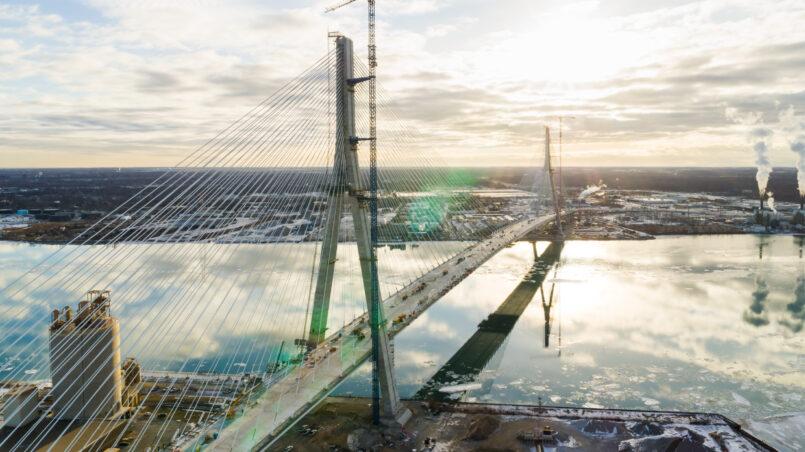
With the completion of the new Gordie Howe International Bridge last month, residents of the Detroit-Windsor metro area will soon have an additional way to cross the Detroit River. But it hasn’t been easy getting here. Almost from its conception, the project has been plagued by drama. And in this edition of TheBridgeGuy, we’ll examine the story of the longest cable stayed bridge in North America.
The Detroit River flows from Lake St Clair into Lake Erie, making it a narrow, natural strait. In fact, the word ‘detroit’ in French means ‘strait,’ except that in French the word is pronounced ‘de-twa.’ Separating the cities of Detroit, Michigan from Windsor, Ontario, the river is effectively the international boundary between Canada and the United States.
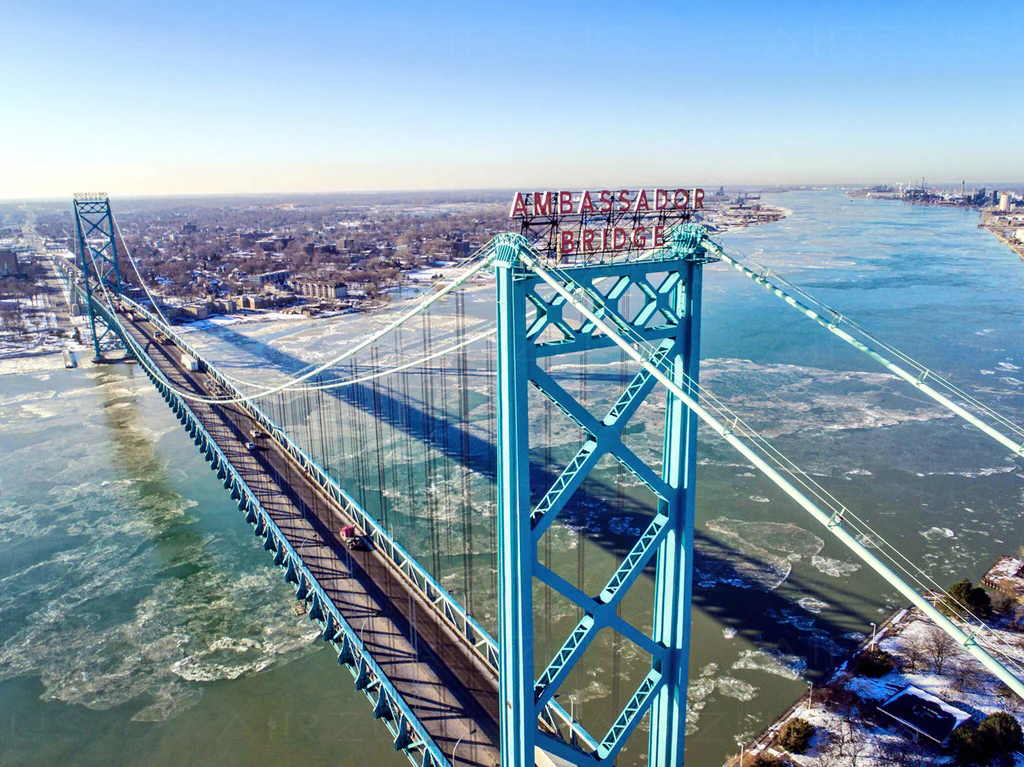
Up to the 20th century, goods and people crossed the river by ferry. In July 1910, the Michigan Central Railway Tunnel opened beneath the river. A suspension bridge for road traffic, known as the Ambassador Bridge, opened in November 1929 and a road tunnel opened in 1930.
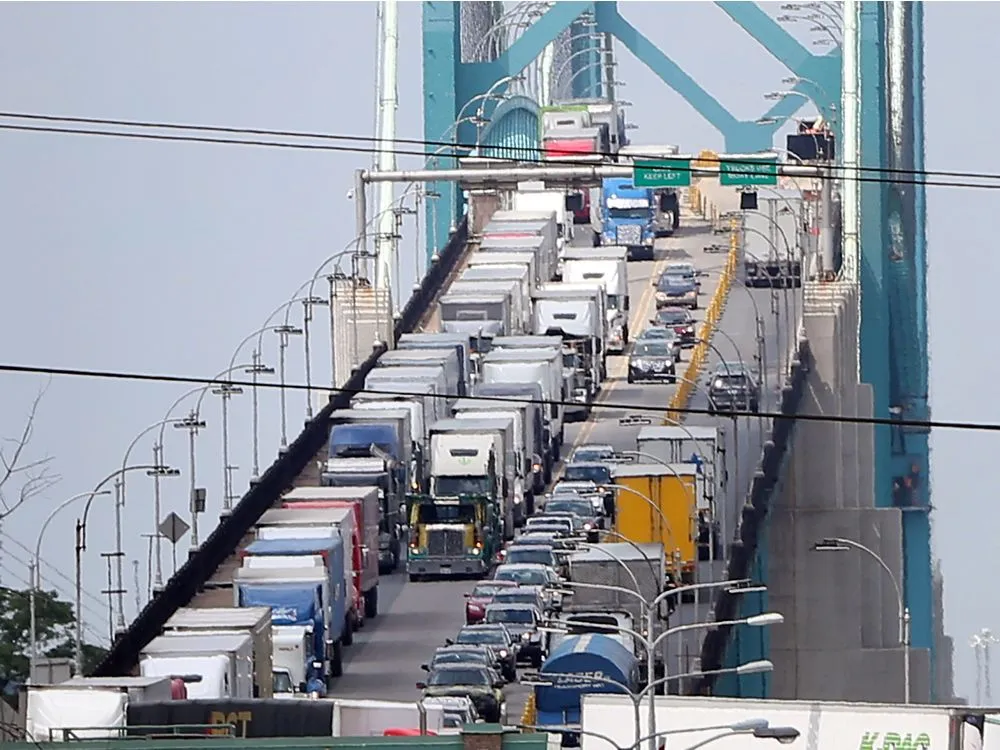
The Ambassador Bridge is currently the busiest crossing between the United States and Canada, with nearly 25% of all truck crossings between the two countries being handled by the bridge. It has been especially important for the automotive industry, with an estimated 150,000 jobs on both sides of the bridge relying on this vital crossing.
Prior to the railway tunnel, railroad freight cars were shipped by ferry. However, the ferries lacked the capacity to deal with the demand, leading to significant transit delays. As early as 1871, tunneling beneath the river was attempted but was eventually abandoned. A bridge with piers in the river was opposed, as it was viewed as a hazard to navigation. A tunnel was eventually completed for the railway in 1910, which eased demand for the ferries.
At the end of World War I, a bridge for road vehicles was suggested as a monument to the war dead. However, neither Michigan nor Ontario wanted to finance a bridge across the river. Michigan automakers decided to take matters into their own hands and finance their own bridge. To back the bridge, they turned to a Toronto financier. Instead of financing the project, he embezzled the bridge funds, murdered a drugstore clerk and committed suicide in prison.
The bridge supporters then turned to Joseph A. Bower of New York, who rescued the company and raised the $12 million needed to finance the bridge project. Henry Ford and other Detroit businesses backed the project, forming the Detroit International Bridge Corporation (DIBC).
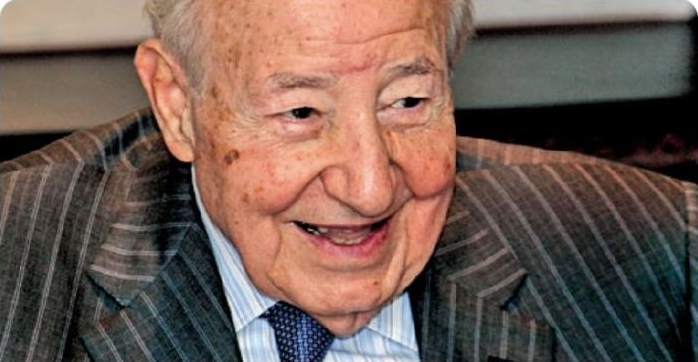
DIBC remained privately managed and run from 1930 until 1979, when the company went public on the New York Stock Exchange. Berkshire Hathaway acquired a quarter of the shares. Local billionaire Manuel Moroun eventually acquired a controlling stake and privatized the company. The Moroun family owns the bridge to this day, including the Ammex duty-free stores and gas stations at the bridge and the railway tunnel on both sides of the river.
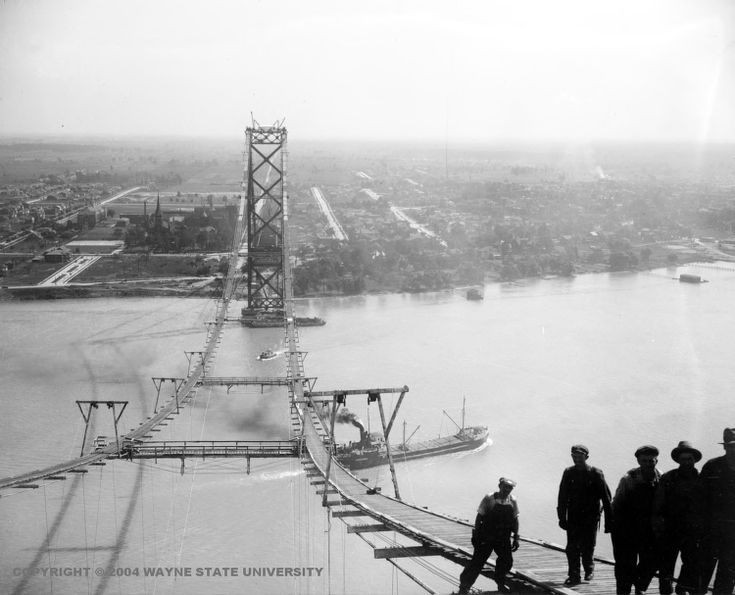
At the time it was built, the Ambassador Bridge had the longest suspended main span in the world at 1,850 feet. This was later surpassed by the George Washington Bridge in New York in 1931. Construction on the bridge began in 1927 and was complete by 1929. The bridge is 47 feet wide, carrying 4 lanes of traffic. Each tower is 386 feet tall and overall the bridge is 7,500 feet long. Originally painted gloss black, the bridge was repainted teal in 2000. The bridge uses 21,000 short tons of steel and the roadway deck provides 152 feet of clearance above the river. More than 10,000 trucks cross the bridge everyday, compared to 4,000 cars.
Despite its importance, the Ambassador bridge has been criticized as a monopoly on transportation in the area. Large trucks are not permitted in the roadway tunnel, thus the only way for truck freight to cross the river is to use the bridge. Private ownership by the Moroun family has also been criticized, with the poor maintenance record being highlighted. In 2009, the Canadian government offered to buy the bridge from Moroun for $2 billion. Moroun wanted $3 billion plus incentives, which the government declined.
In 2015, concrete falling from the bridge was cited as an example of poor maintenance. Moroun accused the government of a smear campaign in favor of the proposed public bridge.
Perhaps the biggest issue with the Ambassador bridge is the lack of highway connections on the Canadian side. Many traffic lights exist between the bridge and Ontario Highway 401, slowing freight transit considerably and adding to significant congestion.
In June 2012, Canadian Prime Minister Stephen Harper and Michigan Governor Rick Snyder announced an agreement that would allow construction on a new crossing to proceed. The project would be financed by Canada, along with property acquisition on the Michigan side and ramp connections to Interstate 75. Construction costs would be repaid by tolls charged on the Canada side, while no tolls will be charged on the Michigan side. Despite the construction being financed by Canada, the bridge would be jointly owned by Canada and the State of Michigan.
Almost immediately, Moroun sued to stop the project. He even went so far as to propose building a parallel span to the Ambassador Bridge, which he would own privately. This proposal was likely fueled by the loss of revenue from duty-free gasoline sales at pumps owned by Moroun near the bridge. Even though nearly 60 cents in gas tax is not charged, the price per gallon is only a few cents cheaper than non-duty-free stations. His suit was thrown out of court, with Moroun lamenting that a public bridge would likely put the Ambassador Bridge out of business.
Between 2007 and 2012, Moroun’s company was granted several permits by both countries to build an adjacent span, two of which directly conflicted one another. The US Coast Guard permit allowed for the additional span provided the existing bridge was retained and rehabilitated. The Transport Canada permit was granted on condition that the existing bridge be demolished. In 2025, the company had abandoned the idea of a second span.
Design for the new bridge was handled by AECOM and their bridge architect Erik Behrens. The 722 foot tall pylons are said to resemble hockey sticks when swung for a slapshot – I don’t see it. The bridge is the longest cable stayed bridge in North America with a main span of 2,800 feet. The bridge carries 6 lanes of vehicle traffic, along with bicycle and walking paths. The superstructure is suspended by 216 cable stays.
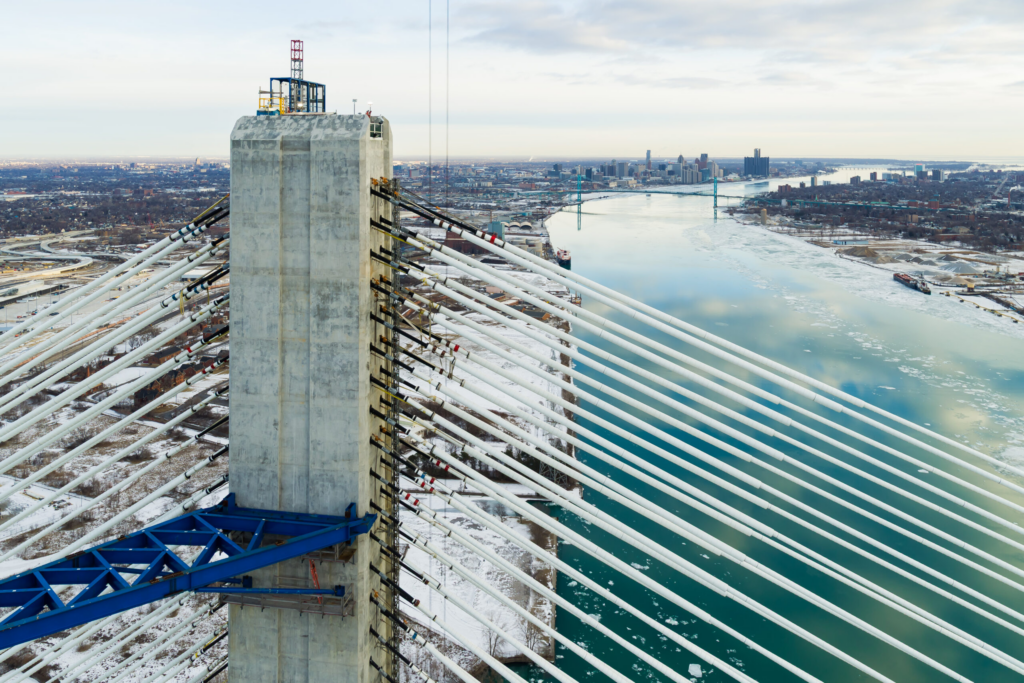
Construction on the new Detroit River crossing began on July 17, 2018. By March 2022, the pylons were complete up to deck level. By November, they had risen to 490 feet. In August 2023, the Michigan pylon topped out and the Canadian pylon topped out in December.
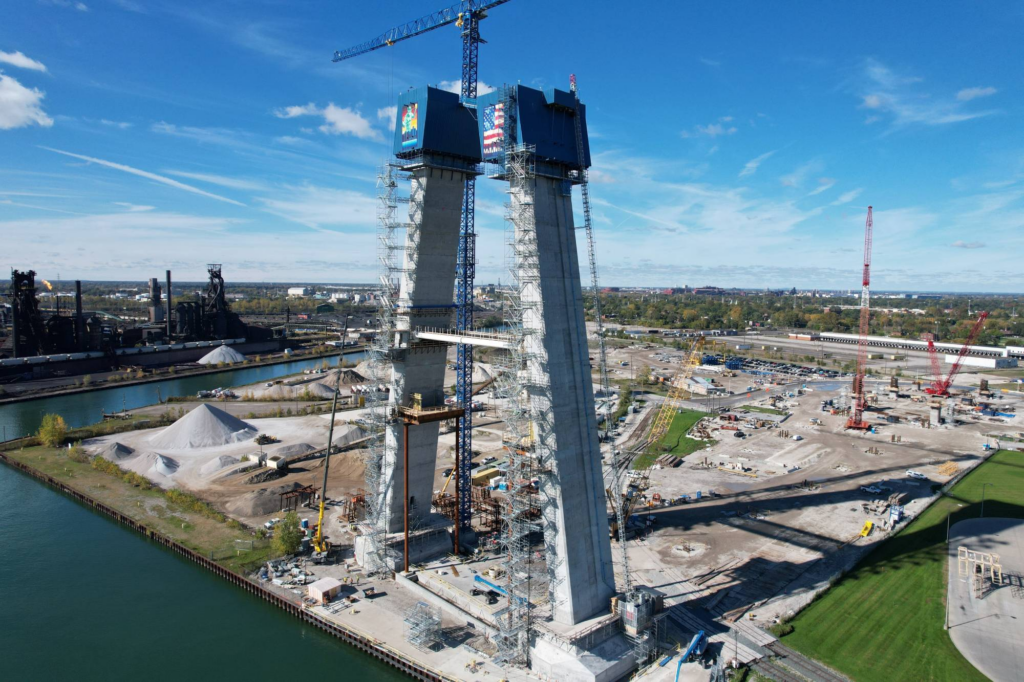
Cable stays began to be installed in May 2023 along with the segmental superstructure. The superstructure is made up of steel edge girders, which are joined by transverse steel floorbeams. Redundant steel girders run parallel to the edge girders. Precast deck panels are used for the deck, and steel soffit panels enclose the structure.
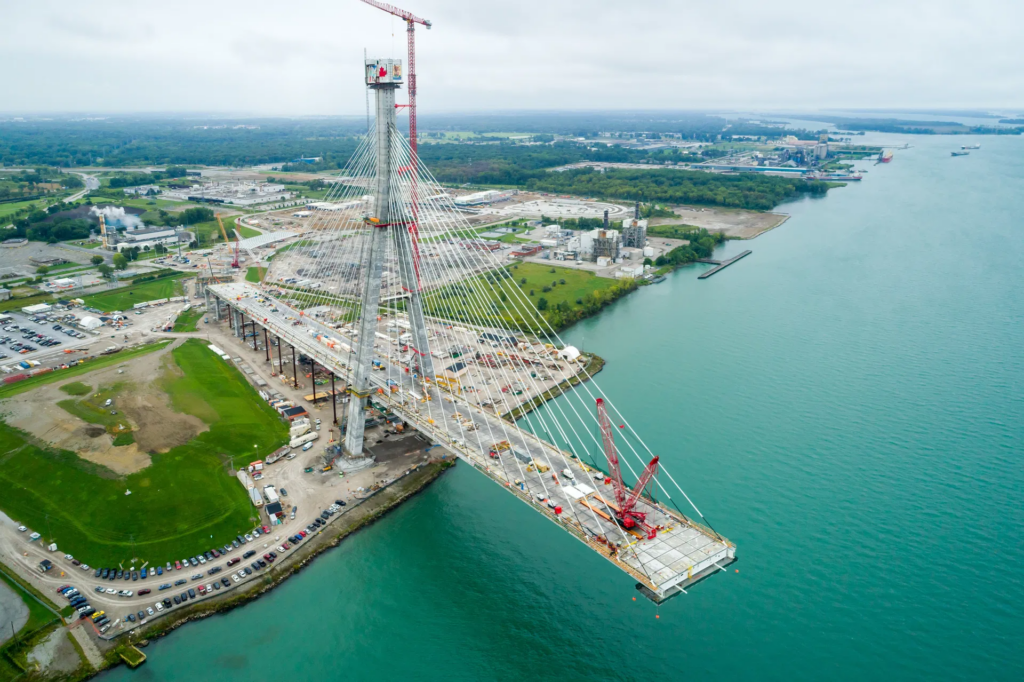
Each half of the superstructure is made up of 27 segments, each about 49 feet long. Upon reaching the center of the main span, the remaining gap is filled with a specially designed 36 foot long segment. The two sides were joined on June 14, 2024, marked by a handshake between a Canadian and American steelworker. At its peak, over 2,800 workers were employed on the project.
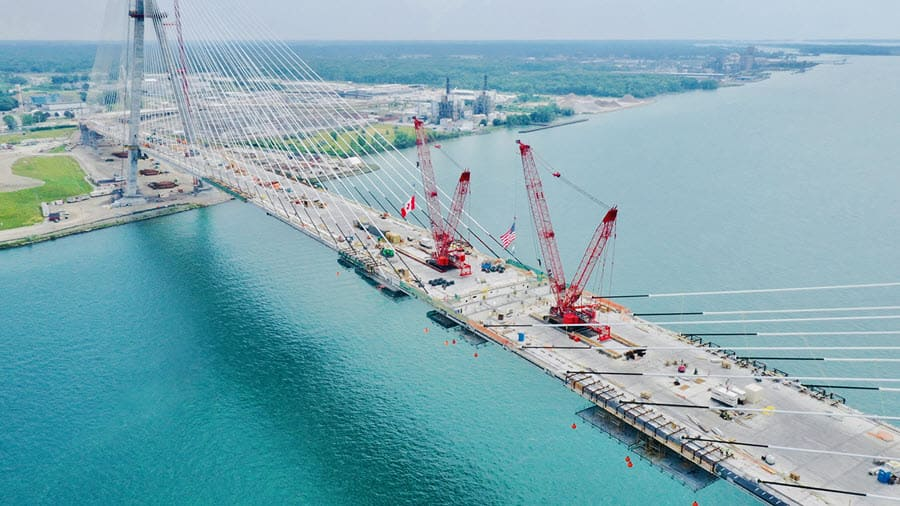
Further drama unfolded in early 2026 when current tensions between Canada and the United States over tariffs and toll revenues threatened to delay the opening of the bridge. Windsor Mayor Drew Dilkens described the timing of the opening as “dreadful.” Originally scheduled to open in 2024, the bridge is now expected to open in early 2026. Delays related to the COVID-19 pandemic were cited for the delay. The entire bridge contract, including ramp connections over its 1.6 mile length is estimated at CA$6.4 billion.
In 2010, the head of the Ontario Trucking Association suggested the idea of naming the new bridge after Gordie Howe. Howe was a Canadian professional hockey player who had spent 25 seasons playing for the Detroit Red Wings. On May 14, 2015, it was announced that the bridge would be named in honor of Howe, who is said to have remarked “That sounds pretty good to me.” Howe died in 2016 aged 88, two years before construction began.
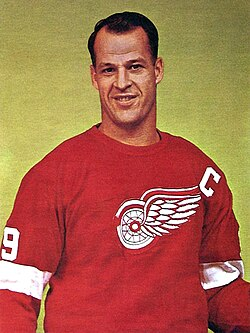
Howe was known for the “Gordie Howe Hat Trick,” which was a goal, an assist and a fight all in the same game. In some ways, the completion of the bridge is one of Howe’s last hat tricks. The overall goal of completing the bridge was accomplished by the Canadian government, with the assistance of the State of Michigan and just happened to include a fight from the Moroun family. Go figure!
1,359