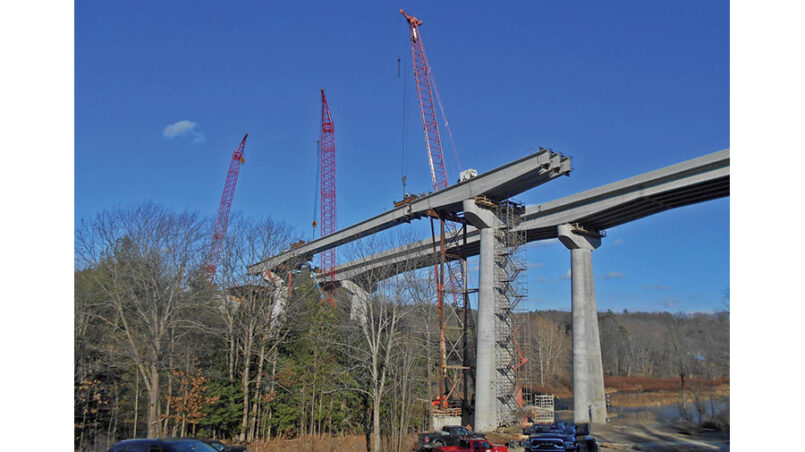
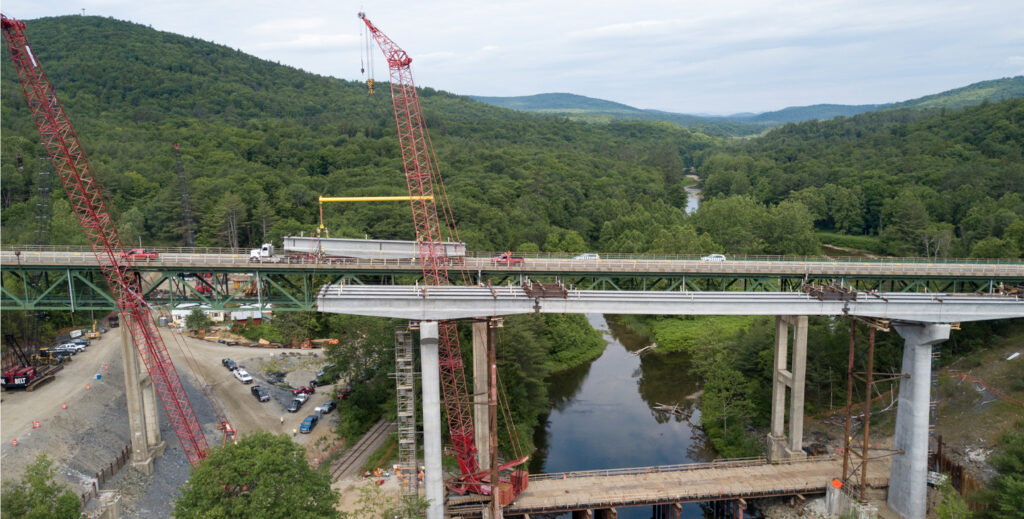
The Rockingham Bridges carry Interstate 91 high above the Williams River in Rockingham, Vermont. When the twin replacement bridges were constructed, their precast concrete spliced-girder spans were among the longest of their kind in New England.
I had the opportunity to work on the design of these bridges, making the Rockingham project a particularly interesting example of how splice-girder construction can solve problems that conventional precast girders cannot.
The project also demonstrates how much bridge construction depends on more than structural calculations. Girder size and weight, transportation routes, erection equipment and construction sequencing all influenced the final design. During construction, the team used techniques ranging from rolling highway slowdowns for girder deliveries to installing bearings on the girders before they were erected.
The result was a pair of bridges designed for a 100-year service life—and a useful real-world example of how very long precast concrete girder bridges can be designed, transported and assembled.
The first girders were erected in June of 2018 and the last girders were erected in February 2020. Once set in place, prestressing strand is pushed into the ducts in the girders and the series of segments is post-tensioned together to form one continuous girder.
While demolition of the northbound bridge involved felling the existing piers like trees, the southbound bridge was a little different. To expedite construction, the new piers were started prior to demolition of the superstructure. This meant that the existing piers had to be removed piece-meal.
The piers look extremely slender for being so tall, and they are. But to get around the contract slenderness limits, two bearings were employed at each girder line at each pier to increase the rotational stiffness, thus modifying the effective length factor of the column which is a measure of the column’s end support conditions.
Much care was taken to achieve a 100 year service life. Extensive use of stainless steel, dense concrete and up-sized H-piles should allow these bridges to stand for many, many years.
The segments used were some of the largest ever fabricated by J.P. Carrara. There were weight limitations imposed on the design as well as height limitations, and the final design is a compromise between a great final design and what is possible as far as lifting and delivery.
Check out these articles, technical papers and presentations which offer more in depth background on the Rockingham Bridge Project.
Design-Build Team Erects Twin Bridges in Vermont by Johanna Knapschaefer – March 17, 2020
Design and Construction of the Rockingham Bridges by Nicholas T. Rodda – September 2017 courtesy of the Western Bridge Engineers’ Seminar.
IBC 18-30: Replacement of the Rockingham Bridges Using Precast Spliced Girders Technical Paper by Chester Werts and Nicholas T. Rodda – June 12, 2018 courtesy of the International Bridge Conference. Paper can be ordered at the link above using the paper number, year and author.
How Splice Girder Bridges Work
The Rockingham Bridges are a real-world application of precast concrete splice-girder construction. For a closer look at why engineers use splice girders, how the individual girder segments are connected, and how post-tensioning allows them to achieve much longer spans, see:
Spanning Further with Splice Girders
3,012






Woah! I’m really enjoying the template/theme of this site. It’s simple, yet effective. A lot of times it’s difficult to get that “perfect balance” between user friendliness and appearance. I must say you have done a very good job with this. In addition, the blog loads extremely fast for me on Internet explorer. Excellent Blog!|
I?d have to contact you right here. Which is not something I usually do! I enjoy reviewing an article that will certainly make people believe. Also, thanks for allowing me to comment!
It?s hard to discover well-informed individuals on this subject, however you sound like you know what you?re discussing! Many thanks
You ought to participate in a competition for one of the best blogs online. I will certainly suggest this website!